“The problem is exclusion, and the solution is inclusion 1.”
All things being equal, those words and their implications are simple enough. I like simple. However, reality shows quite clearly that “all things” are everything but equal. While goals towards being accessible are straight forward, often practicality is a bit more complicated.
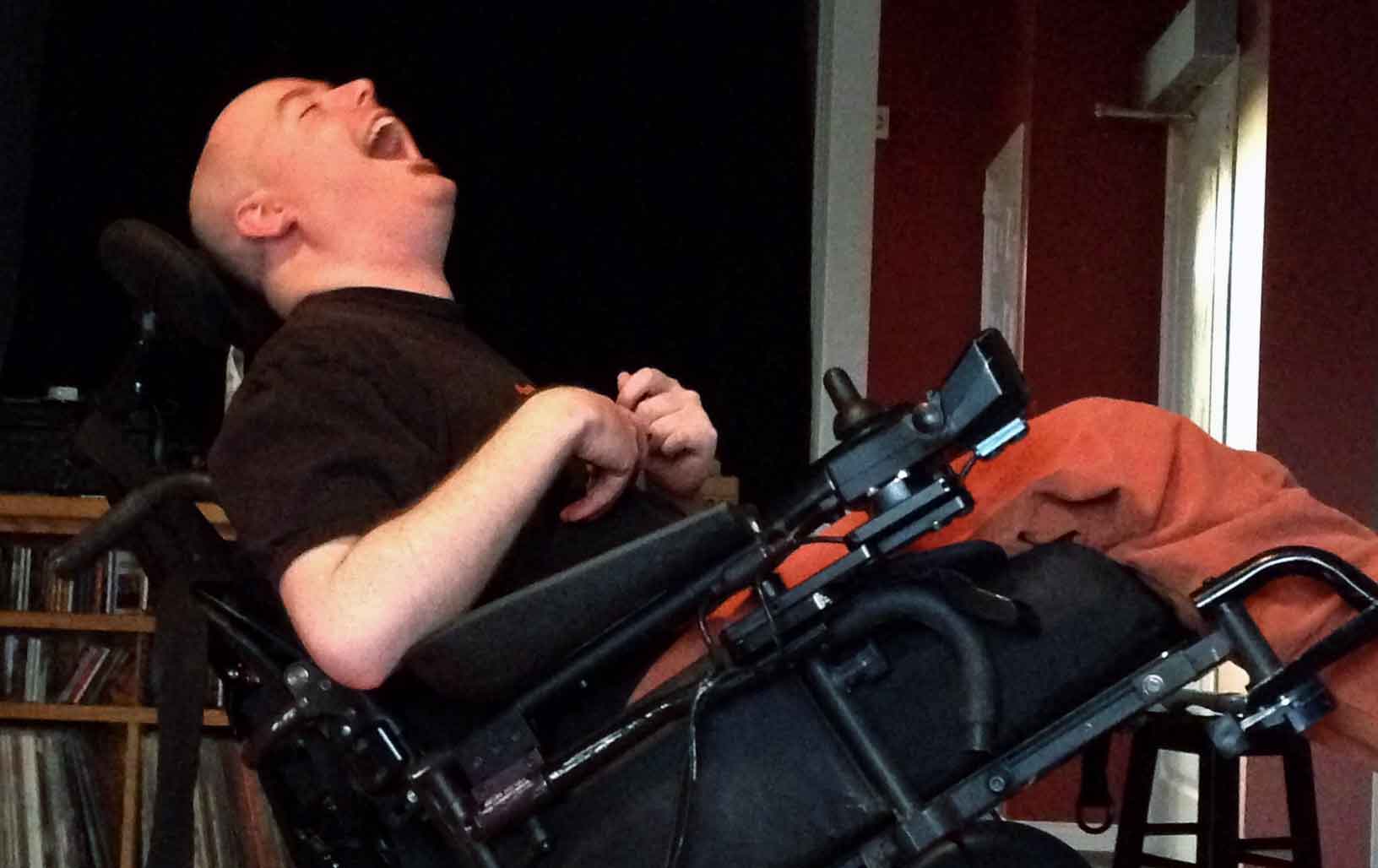
This is me, maniacally laughing at something that hardly justifies such a reaction – guaranteed. (Photo credit: Shitty Sharer and his smelly phone.)
“My name is Johnny, I’m just one of many. And I’m more than a disabled web developer, but not much more. Plus, as evidenced by my continued existence, I’m also a plant powered, stubbornly thriving antifascist!”
On a very early mid-summer morning in nineteen ninety-six, I was a passenger in a car on an ironically sober trip into town from a friends house. See, it was that trip where we spun around on a dark, rural dirt road, slammed into a well anchored roadside tree, (don’t quote me on what we hit, I’ve heard different details, I have no memory of that morning), causing my head to snap straight back over the top of the seat I was siting in, effectively disrupting how my brain communicates with my limbs. Resulting in my quadriplegia.
Fortunately, for both people involved, no-one was killed. Or more accurately at least, I did not stay dead. But if this event wasn’t interesting enough, when I awoke from the coma our accident left me in, I immediately found I was locked-in. Meaning I couldn’t voluntarily move a muscle in my body, aside from being able to blink my eyelids.
Enter my first real personal computer. Thus began my adventure in digital accessibility, it’s primarily why this shit matters to me.
Learning from our mistakes
When a user has an issue using your web site, it’s not the user’s fault; it’s your problem. Shut the fuck up and work to better your efforts! That said, it’s not about getting it right on your first, fourth, or even your hundredth attempt. It’s not even about success at all. It’s about trying our best, while accepting imperfection, and learning from our mistakes. The web is still a relatively young medium, and making mistakes is precisely how we learn.
Putting a fine point on it, access must be abled.
Please, don’t take my words as any sort of suggestion that my efforts are perfect. Or they in any way even remotely resemble good enough. I know they’re not. Better than before is a fine goal to strive for, and that’s what I’m trying to do. But I’ll need some help.
So, should you ever encounter anything you don’t expect using my website, do not hesitate to get in touch and inform me of your experience. I’ve never been more serious. “Don’t let it worry you, we’re down here together. […] heathens, heretics, kids with blue socks 2.” We all have so much to learn from each other. Let’s talk.
After all, if what one is unable to do continues to be used as a means of describing disability, then think about this: every single individual on this planet is disabled. No one person does the same thing the exact same way as another. The reason why is of little consequence. Point is, any one person expecting any one way is, or should be the only way to do anything, is simply mistaken.
Footnotes
- Jean-Bertrand Aristide in mid March 2011 speaking to his nation upon his latest return from exile to his completely beleaguered homeland of Haiti — referencing Fanmi Lavalas, the most popular political party in Haiti, being excluded from an election the country was soon to hold. Return to the inclusion is the answer quote link
- Ego Fum Papa (I Am The Pope), Today’s Empires, Tomorrow’s Ashes, Propagandhi. Return to the kids with blue socks quote link